Be Vincentian: Be a Healer
On Thursday, September 24th, I was invited to five the Vincentian Social Justice Lecture at the annual Vincentian Convocation at St. John’s University.
The Lecture is provided here:
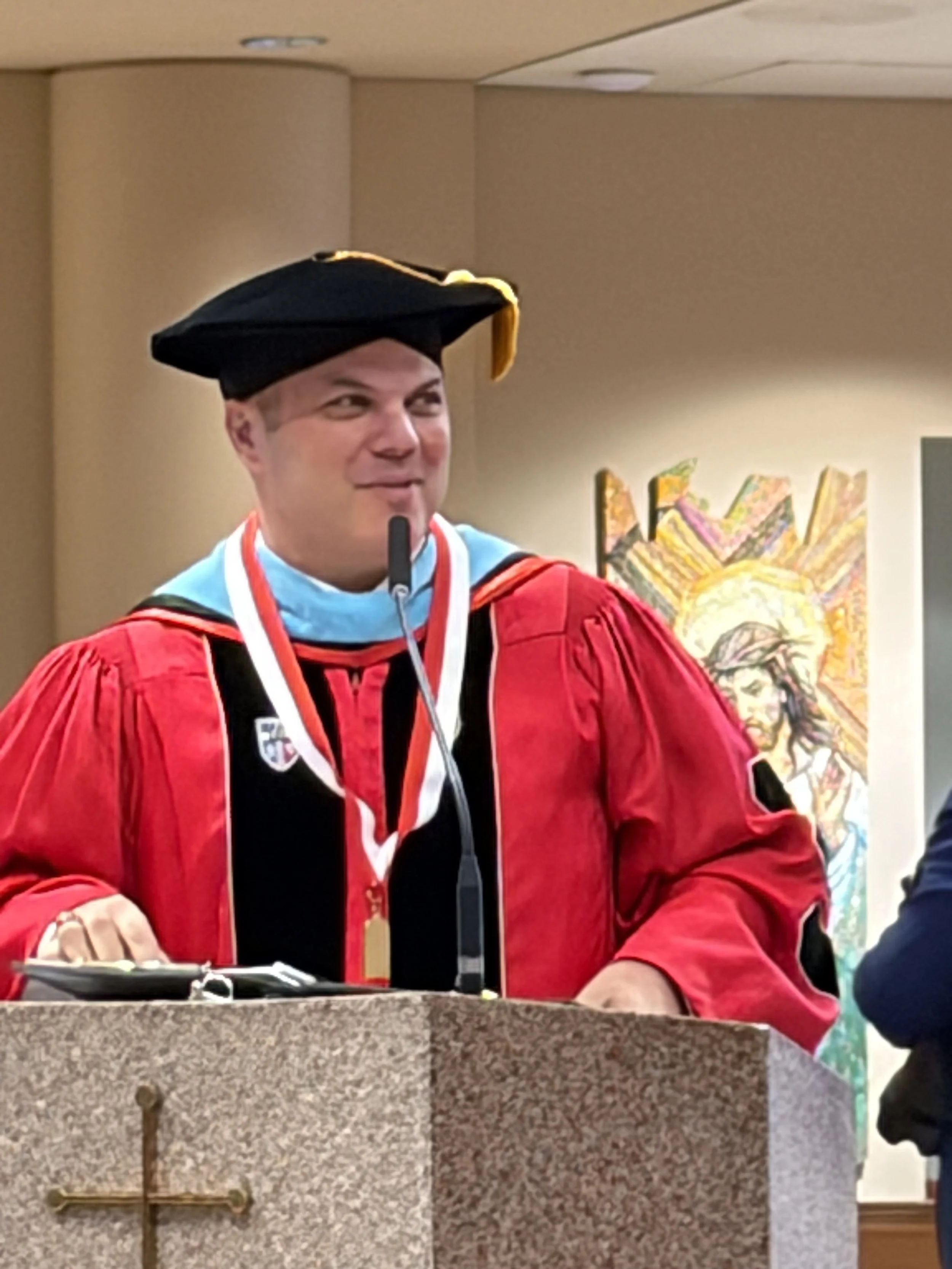
It is great to be home!
We are all here today because of the people who loved us into being, in other words, people who healed us by their love. Would you take, along with me, ten seconds to think of the people who’ve helped you become who you are, those who loved you, healed you. Think of those who cared about you and wanted what is best for you in life.
Take a breath. Close your eyes. Now-remember those who have loved you into being. Ten seconds of silence. I’ll watch the time. (Pause)
Whomever you are thinking about, how pleased they would be to know the difference that you feel they have made. If the people you thought of are still with us, you may want to tell them. If they have already returned home to God, take some time later tonight and offer a silent prayer of gratitude.
Now, I must be honest in this place of higher education where I was taught to always cite my sources, this reflective activity is not an original idea. It is borrowed from a familiar friend to many of us, Mr. Fred Rogers. During an acceptance speech at an award ceremony nearly 30 years ago, he invited those in attendance into this exercise. I have borrowed this activity before, using it in talks and workshops, and every time, including this afternoon, I can see your faces change, light up during these 10 seconds. Tears may have even filled your eyes.
As we explore this year’s Founders Week theme of Be Vincentian, Be a healer, how important it is to first be reminded of how it feels to be on the receiving end of this healing love.
I would like to share three stories with you, three stories that reflect how the Vincentian charism has healed me and continues to call all of us to be healers in such a divided and wounded world.
The first, comes from my time as a student, 25 years ago. The second story, from my second year in ministry at the United Nations, and the third story, from this past year.
Let’s begin…Twenty-five years ago this month, on a sunny Tuesday morning, I sat in an early management class as a sophomore on the 4th floor of Marillac hall. If the window shades were open, I would have seen the smoke fill the Manhattan skyline after two planes hit the Twin Towers. By the time the class concluded, both towers were already gone.
This was a time before laptops in classrooms, and my phone was limited to only making calls and texts, so as the world changed and thousands of lives were lost only 17 miles away, I sat unaware in a classroom.
A few weeks later, I participated in a Campus Ministry leadership program, where my friend and mentor, Bro. Mike Sheerin, asked us, “who is our neighbor?” As the conversation went on, he asked if Osama Bin Laden, the mastermind behind the 9-11 attacks, was also our neighbor. What a question, and one that I can remember instantly answering with a profound “no.” We wrestled with this question of who are neighbor was, and to be honest, I am still wrestling with it.
As we look back, 25 years since 9/11, we can see that by responding with violence and engaging in new wars, millions more have unnecessarily suffered and died.
We must ask as violence and war surrounds , when will we ever learn? Violence only breeds more violence.
According to the Geneva Academy, there are currently more than 110-armed conflicts globally. Violence is overwhelming all parts of the world. In an attempt to feel the magnitude of this reality, consider that by the time this short lecture concludes, 36 people would have died from violence-related injuries.
And violence is expensive. Last year alone, nearly 3 trillion dollars was spent on war. Just imagine how that money could have been used to feed the hungry, house the homeless, educate and protect our children, and heal the sick.
Instead, what did it buy us? Just more destruction and a continued cycle of pain and loss.
Yes, our wounded world desperately yearns for healing, and we, as people of faith, are called to respond. We must live differently, by responding with peace and love- even under the most painful of circumstances.
St. Mother Teresa, who in 1976 was honored by St. John’s on this very campus, rightly said, “If we have no peace, it is because we have forgotten that we belong to each other.”
St. Vincent de Paul also reminds us, “We must love our neighbor as being made in the image of God and as an object of his love.”
We must decide my friends, which side we are on. That of destruction or that of peace?
If it is peace, it will impact how we spend our money and time, who we vote for, how we forgive those who hurt us, how we seek and provide compassion and empathy, and how we love without condition. Yes, it is difficult, and yes, it is probably a life-long task, but isn’t it better than the alternative?
My second story comes from my second year in ministry at the United Nations. In representing the Sisters of Charity Federation, I join other faith-based and Vincentian NGOs in not only advocating for human rights, but for human dignity.
And isn’t it appropriate as the world’s leaders meet to discuss the problems of the world at the UN’s General Assembly just 12 miles away, we gather here today to reflect on the power of a healing love that is rooted in prayer and action.
I spent my first-year at the UN learning how this massive and complicated global organization functions. In my second year, I was overwhelmed by the horrific data of human suffering.
Allow me to share with you just some of the astounding and heart-breaking statistics that are the focus of our advocacy at the United Nations.
· 8 percent of the global population, 645 million people, goes hungry. That is nearly twice the entire population of the United States.
· 700 million people worldwide live on less than $2.15 a day. I spend nearly double this on an iced coffee from Dunkin Donuts.
· 1 in 3 women and girls experience physical or sexual violence.
· One-third of the world’s population live in inadequate housing, and lack secure land, basic water and sanitation services.
· And finally, millions die each year due to rising temperatures, severe droughts, forest fires, and polluted air.
How do you even begin to process all these statistics? How do we even begin to change these realities for our human family, and how do we begin to heal the trauma that so many are experiencing due to these injustices?
Now, I do not share all this to ruin your afternoon or make you feel helpless. Rather, it is just the opposite.
We are people of hope. Yes, we hope that love always wins, that God is always present, that our charity matters, and that our advocacy will contribute to the transformation of the systems that cause injustice, even if it takes many generations. We are, as Cardinal John Dearden reminds us, prophets of a future not our own.
We must know the difference of what is ours to do and what is God’s, and we must open our hearts to allow this divine spirit to teach us, guide us, transform us.
A pivotal moment when my heart was broken open occurred in my second year at the UN when I met with 8 members of an Indigenous tribe from the Amazon. We listened attentively as they spoke of their painful reality as they were losing lives, land, and precious resources. They traveled more than 5,000 miles to New York to tell their stories to Member States, praying that the powerful would first care, and second, act.
I couldn’t help but wonder about their community back home. How hopeful they must have been that their land and lives would now be protected once the United Nations heard their plea. I struggled knowing that their hope would likely lead to disappointment and even more pain. It is one thing to read the data of the difficulties facing the nearly 3 million indigenous people in the Amazon. It is another thing to sit in a room with 8 brothers and sisters who were only asking for their rights and dignity to be upheld.
As I left the UN that evening, I found myself suddenly thinking of St. John’s, and how important an institution like this is. St. Johns, a Catholic and Vincentian University is forming students to know and love the most vulnerable, to seek charity and justice, and to use their God-given talents to improve the lives of others, even for those thousands of miles away.
In a moment of sadness and frustration, I found hope because of the mission of this institution, and all Catholic and Vincentian institutions of higher education, to form the next generation of leaders and healers. What a privilege it was to be a part of this mission for 23 years as a student and employee, and my appreciation for what this University does for the world only continues to grow.
With so much sadness, so much inequality, we must be people of hope and find our path to heal what is broken. And this leads us into my third, and final story.
In July 2025, I was diagnosed with Stage IV Colon Cancer. As you can imagine, it was shocking. On some days, it still is. Surgery quickly followed, and this past July, I completed 24 rounds of chemotherapy. I will undergo a significant surgery next month to remove a cancerous tumor on my diaphragm.
From the moment I learned of this diagnosis, I immediately asked, “What good can come from this?” Of course, I journeyed through all the emotions that come with cancer, but I wondered, what will this healing journey teach me? How might it help others who are suffering? How will I come to know Christ in a deeper way?
Franciscan author and priest, Fr. Richard Rohr said that there are two universal paths to God and spiritual transformation: they are great joy and great suffering. Experiencing joy, like the birth of your children, changes you. So does suffering, such as when a loved one returns home to God, an unexpected accident, or an alarming medical diagnosis.
It is prayer that allows us to discern how suffering is a path to God. In reflecting on this past year, I can see how my prayer transformed my whole being in a way that is only possible when you start to hear the ticking of life’s clock.
As Vincentian healers, prayer is essential. Prayer reminds us of who we belong to, and who we are called to be. Prayer calms our heart, centers our mind, and nudges us forward. It is prayer that strengthens this divine relationship with our God who dwells within me and dwells within you.
It is prayer that moves us from contemplation to action, especially when we feel the heavy weight of the world’s injustice that wounds humanity and creation.
It is prayer that keeps bringing us back to that wonderful Vincentian question, “What must be done.”
St. Vincent and St. Louise answered it in their own way in their unique time in human history. For over 400 years, others in the Vincentian spirit, such as St. Elizabeth Ann Seton, Blessed Frederic Ozanam, and Blessed Rosalie Rendu, responded to the question with charity and justice.
Now, my friends, it is our turn.
How will you, how will I, how will we, respond to that pivotal Vincentian question, What must be done? How might we heal our wounded yet beautiful world?
The good news is that we do not go about this alone. We do not answer this “What must be done” question in isolation. Rather, we answer it together. Not just with those we serve with, but also with those we serve and advocate for.
Those with the lived experiences of injustice teach us how to serve and how to advocate. We do this first by listening, then by helping create space so everyone has a seat at the table, and by supporting that their voice is heard and experiences are valued.
And how wonderful it is that we respond to this “What must be done question,” not as one individual, but as part of a family, the Vincentian family, consisting of over 4 million members in 150 countries. And we join people of all faiths and kind hearts in seeking harmony and a better world. And there are many.
At a time in our country when empathy and compassion is being met with resistance and judgment, how encouraging it is to see so many people meeting this moment with courage, serving as instruments of God’s love, healing, and peacemaking.
We are also blessed by our own communities of friends and family, those who love us, teach us, guide us, those who heal us and as we explored earlier, those loved us into being.
I am blessed to have some of my friends and family with me today, including former and current colleagues, spiritual mentors, dear friends, representatives of the Sisters of Charity Federation and the Daughters of Charity, whom I represent at the UN, and the Vincentian fathers. I am so grateful that also here today is my wife Suzie who I met for the first time here in St Thomas More Church 19 years ago, my girls Shea and Lily, as well as my parents, my mother-in-law, my sister, and my niece and nephews. We are truly a St. John’s family, with 9 degrees earned among us, and I suspect more to come.
The bottom line is if we wish to be healers for our world today, we must be people of prayer, we must be in collaboration and relationship with others, especially those facing injustices, and we must find comfort and strength in the various communities we call home.
Finally, we must also recognize that we do this, not as perfect people, but as wounded people.
Each of us brings our own crosses, our past trauma, our fears, concerns, and limitations. Yet, we look at the suffering in our communities and in our world, and our heart stirs. We stop, we pray, and then we turn our pain into our purpose.
Didn’t St. Vincent and St. Louise face personal loss and suffering too? Yes, they struggled, but they also focused their hearts on Christ and their energy on improving the spiritual and material lives of others. Their healing love set the world on fire, a fire that continues to burn within us, today.
This divine healing love is on display in the lives of today’s honorees and the organizations they represent. May we leave here inspired by their example, and may we recommit to bringing God’s healing love to others, especially those most vulnerable in our world.
When I started this reflection, I invited you to take 10 seconds to recall those who loved you into being, those who healed you by their love. I conclude this reflection by asking you to consider all those in your life, if asked the same question, who would think of you? Those lives you healed by your gentle touch, your listening ears, your open heart, your helping hands, your advocating voice, your prayer.
What an honor it is to have impacted the life of another, that they may know of God’s healing and unconditional love because of you.
I am forever grateful to St. John’s University, and to the larger Vincentian family, for this honor this afternoon and the opportunity to provide this reflection. Thank you Fr. Shanley, Fr. Griffin and the selection committee, Fr. Rooney, University Events, University Mission and Ministry, and all who made this afternoon possible.
How wonderful it is be home and to walk this journey of healing and of love together.
Thank you!